Excellent
Next day delivery! Depending on Availability*
Here to help! Monday to Friday, 8:30AM-5:30PM*

5 Conference Room Technology Trends Shaping the Future

Conference room technology trends

In modern workplaces, conference rooms are crucial for communication, collaboration, and productivity. As technology advances, conference room technology trends have evolved to support the needs of modern businesses. Conference room technology has come far from traditional phone and projector setups. Today, audiovisual technology is an essential component of modern conference rooms. 

By adopting five conference room technology trends-

  • video conferencing
  • voice recognition technology 
  • wireless presentation
  • virtual and augmented reality
  • artificial intelligence (AI)

businesses can improve communication, collaboration, and productivity in the modern workplace. 

Conference room technology trends are evolving rapidly, driven by the shift towards remote work and digital transformation. The latest conference room tech updates, such as meeting room design and communication technology, have also received increased attention, with businesses looking to optimise their technology for virtual meetings and smart office environments. Keeping up with the latest conference room technology trends is essential for businesses to stay competitive and improve communication.

Trend #1: Video conferencing

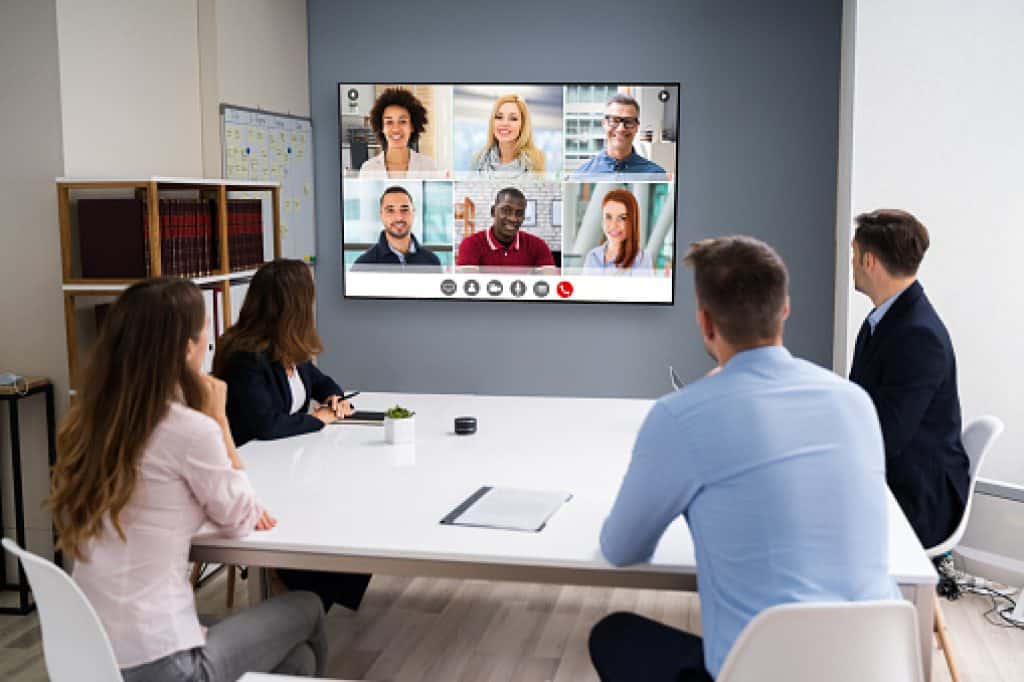
Video conferencing software like Zoom and Microsoft Teams have become ubiquitous in today’s workplace. These platforms provide high-quality audio and video capabilities for virtual meetings, making it easier for teams to collaborate and communicate. This technology is one of the most significant conference room technology trends of the digital age, enabling businesses to collaborate remotely and work together more efficiently. 

Some advanced features of video conferencing software include screen sharing, virtual backgrounds, and recording capabilities. 

  • Screen sharing enables participants to share their screen with others, making presenting information, showing slides, or reviewing documents easier.
  • Virtual backgrounds enable participants to customise their backgrounds, making the meeting more fun and engaging.
  • Recording capabilities allow participants to record the meeting, which can be useful for people who cannot attend the meeting or for future reference.

Video Conferencing Trends

AI-powered cameras and virtual backgrounds are two of the latest conference room technology trends revolutionising how businesses conduct virtual meetings. AI-powered cameras use advanced algorithms to track and zoom in on speakers, making it easier to follow the conversation and stay engaged during virtual meetings. Virtual backgrounds, on the other hand, allow users to change their backgrounds to a virtual setting, giving the impression of a professional workspace, even when working from home.

Other notable conference room technology trends include huddle and meeting room technology. Huddle room technology is designed for small group collaboration and enables teams to work more flexibly and agilely. On the other hand, meeting room technology is designed for larger groups and can include features such as interactive whiteboards, digital signage, and video walls.

Examples Of How Companies Use Video Conferencing To Improve Collaboration

Many companies have adopted video conferencing technology to improve collaboration and streamline workflows. For example, software company uses video conferencing to bring their global team together and collaborate in real-time. Similarly, healthcare companies use video conferencing to enable doctors and healthcare professionals to collaborate on patient care, regardless of location.

Other examples that use video conferencing include consulting firms that use video conferencing to enable their team to work remotely and collaborate with clients worldwide. Video conferencing provides remote training and support to employees and customers, ensuring they stay updated with the latest technology trends.

Trend #2: Voice recognition

One of the most exciting developments in recent years in conference room technology is the rise of voice recognition technology. This technology is transforming how we interact with conference room technology, making it more intuitive, user-friendly, and efficient. The integration of voice recognition technology takes it to the next level. Using voice commands, users can quickly and easily control their presentation, meeting technology, and communication tools, improving productivity and efficiency.

The use of voice recognition technology also plays an essential role in meeting room design and communication technology. By eliminating the need for physical buttons and switches, it streamlines the design of conference rooms and improves the user experience. Adopting voice recognition technology is a critical aspect of digital transformation and smart office solutions. It enables cloud collaboration and wireless presentation systems, increasing productivity and seamless communication.

Voice Recognition Trends

As we look towards the future, exciting advancements in conference room technology are on the horizon. Futuristic conference room technology will include AI-powered virtual assistants, holographic displays, and gesture-controlled interfaces. These upcoming conference room technologies will transform how we conduct meetings and collaborate with others.

  • AI-powered virtual assistants are designed to provide users with a personalised and intuitive experience where they can interact with technology using natural language. These virtual assistants use machine learning algorithms to understand user behaviour and preferences, enabling them to provide personalised recommendations and support.
  • Holographic displays are another innovative technology set to transform conference room technology. These displays use light projection to create 3D holographic images that can be viewed from different angles. This technology allows users to visualise information in a new and immersive way, enhancing the effectiveness of presentations and collaborative sessions.
  • Gesture-controlled interfaces are yet another exciting technology set to change how we interact with conference room technology. These interfaces use sensors to track hand and body movements, allowing users to control technology through gestures and movements. This technology provides a more natural and intuitive way to interact with technology, making it easier and more efficient to conduct meetings and collaborate with others.

These advanced technologies can potentially transform the conference room experience completely. With AI-powered virtual assistants providing personalised support, holographic displays delivering immersive visual experiences, and gesture-controlled interfaces providing intuitive and natural interaction, the conference room of the future promises to be a more productive, engaging, and innovative space.

Examples Of Companies Using Voice Recognition To Streamline Meetings

Several companies have adopted voice recognition technology to streamline meetings. For instance, Cisco Webex Assistant is an AI-powered voice assistant that can help participants join meetings, take notes, and provide follow-up action items. Similarly, Zoom’s virtual assistant, Zoom Assistant, allows users to launch meetings, record and transcribe meetings, and create and manage meeting invites.

Trend #3: Wireless connectivity

Wireless presentation tools are an excellent way to boost productivity and meeting collaboration. It makes it easy for multiple participants to share content and collaborate on projects. This can lead to more creative and innovative solutions and better decision-making. It is essential to have easy-to-use and reliable conferencing solutions, ensuring business communication runs smoothly. Many companies are adopting wireless presentation systems, allowing presenters to share their screens without cables or cords. This reduces clutter in the conference room and makes it easier for participants to share their screens and collaborate on projects. Examples of wireless presentation systems include Barco ClickShare and Airtame.

Wireless Connectivity Trends

As we move towards the future, staying up-to-date with the latest conference room tech updates and embracing the latest futuristic conference room technology to stay ahead of the curve is crucial. As part of the latest conference room technology trends, wireless charging and Bluetooth-enabled devices have become increasingly important in improving productivity and collaboration.

  • Wireless charging technology allows devices to be charged without cables, making it more convenient for users to charge their smartphones and laptops during meetings. With the latest wireless charging technology, users can charge their devices at a distance, making it easier to stay connected without worrying about cables and power sockets.
  • Bluetooth-enabled devices, on the other hand, allow users to connect to various devices wirelessly, enabling easy communication and collaboration. With the latest Bluetooth-enabled devices, users can easily share information and presentations, making meetings and virtual conferences more productive and efficient.

Trend #4: Virtual and augmented reality

Conference room technology trends constantly advance, and virtual and augmented reality significantly transform meeting rooms into advanced collaborative spaces. Businesses invest in cutting-edge audio-visual technology and collaborative tools to enhance virtual meetings and productivity. Integrating AR & VR creates new possibilities for conference room design, enabling users to experience immersive digital environments that can transform how meetings are conducted.

Virtual and augmented reality can provide a futuristic conference room technology experience by offering the ability to conduct meetings in virtual environments with realistic audio and visual representation. These technologies can improve remote work by simulating face-to-face communication with colleagues, allowing users to interact with each other in a more natural and intuitive way. This approach can facilitate collaboration among team members who are geographically dispersed and improve the communication experience for all attendees.

Moreover, virtual and augmented reality can enhance presentation tools by enabling users to showcase their products and services in an interactive and engaging way. This can be particularly useful for architecture, engineering, and construction businesses, where virtual environments can create 3D models and simulate real-world scenarios. This technology can also help businesses with digital transformation and workplace technology adoption, leading to more efficient and productive meetings.

Latest AR & VR Trends

Upcoming conference room technology will likely include more immersive experiences and advanced productivity tools. Businesses that want to stay ahead of the curve must keep an eye on the latest conference room technology trends and be ready to embrace them. Futuristic conference room technology includes VR headsets and AR overlays that can create an immersive experience for users. These technologies enable users to collaborate in real time and provide a more engaging experience for remote teams. 

  • VR headsets are devices worn on the head that use virtual reality technology to create immersive, three-dimensional environments. They typically consist of a headset that covers the eyes and displays images on small screens in front of each eye. The images are rendered in 3D, and the headset tracks the user’s head movements, allowing the user to look around and interact with the virtual environment. Several types of VR headsets are available on the market, ranging from high-end models that require a powerful PC or standalone models with built-in hardware that don’t require an external device.
  • AR overlays use augmented reality technology to overlay digital information onto the real world. AR overlays can be viewed through a smartphone or tablet camera or a dedicated AR headset. AR overlays use sensors and cameras to detect the user’s surroundings and then project digital images onto the real world in real-time. This can create interactive experiences that combine digital and physical elements, such as training tools, advertising campaigns, etc.

Overall, both VR headsets and AR overlays are exciting technologies that have the potential to revolutionise the way we interact with digital content and the world around us.

Trend #5: Artificial intelligence (AI)

Artificial intelligence (AI) is the simulation of human intelligence in machines programmed to learn, reason, and solve problems. Businesses worldwide have started to adopt AI in various ways to improve operations, enhance productivity, and increase profitability. Conference room technology trends have also seen the introduction of AI-driven tools and solutions that have transformed traditional meeting spaces into high-tech collaborative zones.

Implementing AI-powered audio-visual technology has facilitated remote work and eliminated the need for physical meetings. The latest conference room technology solutions now incorporate presentation, communication, and productivity tools to provide a modern workplace environment that boosts productivity and efficiency. Cloud collaboration is one of the aspects that has been transformed with AI, facilitating wireless presentation and conferencing solutions. The conference room design and meeting room equipment are now planned with the latest conference room tech updates in mind, allowing businesses to implement futuristic conference room technology.

As we look forward to 2023, conference room technology trends are expected to advance even further. AI-powered solutions will continue to shape how we conduct meetings, enhancing the communication experience and creating a more productive work environment. To take advantage of the latest conference room technology, businesses must be open to adopting new ways of conducting meetings and implementing technology that supports remote work and virtual meetings.

The Current State Of AI Technology In Conference Rooms

Conference room technology trends constantly evolve, and AI technology is at the forefront. Technology facilitates communication and collaboration in conference rooms as businesses adapt to the changing workplace landscape. One of the most significant trends in conference room technology is integrating AI-based audio-visual technology. Collaborative tools for remote teams are now a requirement for modern workplaces, with virtual meetings being the norm.

In future, it is clear that AI technology will continue to be a driving force behind these innovations. The latest conference room technology will be even more user-friendly and intuitive, and futuristic conference room technology will be even more integrated into the office fabric. AI-powered communication tools will become increasingly important as businesses look to optimise communication and collaboration. Productivity tools that utilise AI technology will become more common, making it easier for businesses to optimise their workflow and maximise efficiency. 

Examples Of AI technology That Is Changing The Game.

With the onset of digital transformation, workplace technology has been revolutionised, and collaborative tools have taken centre stage. Some examples of AI technology are changing the game in conference room technology trends:

  • One of the most significant changes in conference room technology is the advent of video conferencing. With the help of AI, video conferencing solutions have improved to a great extent. Companies such as Zoom and Cisco have integrated AI algorithms into their platforms to provide users with automatic noise cancellation, virtual backgrounds, and live transcription features.  
  • Another area where AI is making a significant impact is the design of meeting rooms. Modern conference room technology involves much more than just audiovisual technology. It’s about creating an environment that fosters collaboration and boosts productivity. AI is being used to optimise meeting room design and improve communication technology. For instance, huddle room technology involves using AI-powered devices to create small meeting spaces that facilitate collaboration and communication among team members.
  • Cloud collaboration tools have become ubiquitous in modern workplaces. With the help of AI, these tools can analyse data and provide insights that help teams work more efficiently. For example, wireless presentation systems are being integrated with AI algorithms to create smart office environments where meetings can be conducted seamlessly.

Conclusion

In today’s digital transformation, workplace technology is key, and presentation tools and meeting technology are no exception. Cloud collaboration, huddle room technology, and wireless presentation systems are all productivity tools that can make a big difference. Don’t fall behind on the latest conference room technology trends – upgrade your meeting room technology and communication tools today!

Keeping up with the latest meeting room design and communication technology can have a significant impact on productivity and efficiency. By embracing the latest conference room technology, businesses can stay competitive and ensure they are providing a modern workplace for their employees. Investing in the right audio visual technology, video conferencing capabilities, and collaborative tools can improve productivity and enable remote work and virtual meetings.

Picture of Meeting Store

Meeting Store

Table of Contents

AV skills elevation
Training and Education

Elevate Your AV Skills with Expert Training

In today’s fast-evolving digital landscape, the importance of AV skills cannot be overstated. With multimedia proficiency and audiovisual expertise becoming essential in various fields, understanding the concept of AV skills elevation is crucial. This article will delve into the world of AV skills, their significance, and how to elevate them to achieve multimedia production excellence.In an era driven by multimedia and interactive media design, AV skills have become indispensable. Whether you’re a student, a professional, or an aspiring content creator, the ability to master audiovisual technologies is a gateway to success. AV skills encompass a wide range of competencies, including video editing techniques, visual communication, multimedia storytelling, and audio production.AV skills elevation is the process of enhancing your audiovisual proficiency, allowing you to excel in the digital landscape. This concept involves expert training to optimize AV equipment, create compelling multimedia content, and deliver immersive multimedia experiences. By improving your multimedia production skills, you can enhance your multimedia storytelling mastery and elevate your video presentation capabilities.AV for Education: Classrooms, Lecture Halls, AV Control  Starting from Scratch: AV Skills Training for BeginnersAV skills elevation is the cornerstone of mastering audiovisual technologies for beginners. In the rapidly evolving world of multimedia proficiency, laying a strong foundation through expert training is paramount. Understanding the significance of foundational training is pivotal in today’s digital landscape.Foundational Training: Building the BasicsFoundational training forms the bedrock of audiovisual expertise. Novices embarking on their multimedia journey must grasp the fundamentals of video editing techniques, interactive media design, and visual communication. These skills are not just tools; they are gateways to effective storytelling through AV. Immersive multimedia experience begins with a deep understanding of audio production, presentation skills, and AV equipment optimization.Resources and Courses: Nurturing NovicesFor beginners seeking multimedia proficiency development, a plethora of resources and courses await. Expert training programs delve into multimedia content creation, offering a roadmap to enhance video presentation skills. Interactive media mastery is achieved through hands-on guidance, and high-quality sound production becomes second nature. Novices can optimize AV equipment for quality, thanks to specialized workshops that focus on effective storytelling through AV. Course Description AV Skills Mastery Comprehensive training in multimedia production Multimedia Storytelling Techniques for Immersive Storytelling Interactive Media Design Best practices for engaging user experiences Audiovisual Proficiency Development of skills in AV industry knowledge Enhance Video Editing Mastering advanced video editing capabilities Navigating the AV Landscape: Expert GuidanceElevating presentation skills and multimedia production skills requires expert AV training. AV skills enhancement is not just about technical prowess; it’s about developing a holistic approach to multimedia storytelling mastery. Novices can explore advanced audiovisual techniques, interactive media design, and multimedia production excellence under the guidance of seasoned professionals.Tools and Software: Empowering CreativityProfessionals in the field recommend top-rated multimedia training programs and the best video editing courses. Interactive media workshops provide in-depth knowledge about advanced audiovisual techniques. Multimedia content creation platforms and expert video editing software empower beginners to bring their creative visions to life.  Mastering Audiovisual TechnologiesIn the ever-evolving realm of audiovisual (AV) technologies, the pursuit of AV skills elevation is paramount. With the relentless growth of multimedia proficiency, staying updated in this dynamic field is essential. This section delves into mastering audiovisual technologies, explores advanced techniques, and emphasizes the importance of continuous learning.Advanced Audiovisual TechnologiesAudiovisual expertise has expanded far beyond traditional boundaries, encompassing a multitude of disciplines, including video editing techniques, interactive media design, visual communication, and audio production. The modern multimedia storytelling landscape requires a holistic understanding of these components, promoting a more immersive multimedia experience.AV equipment optimization plays a vital role in delivering high-quality sound production. In the context of multimedia content creation, it is imperative to enhance video presentation skills and elevate video editing capabilities. This involves the mastery of advanced audiovisual techniques, such as interactive media design and multimedia storytelling.Staying Updated in the AV IndustryIn the AV industry, change is constant, and staying abreast of the latest trends and technologies is critical for success. Effective storytelling through AV requires in-depth knowledge of evolving multimedia production excellence, which can be achieved through continuous learning and expert AV training.AV Skills EnhancementAV skills enhancement is a continuous journey. It involves honing multimedia proficiency and embracing advanced AV techniques. Aspiring professionals can benefit from expert video editing tutorials, immersive multimedia learning, and advanced AV techniques guides. These resources provide valuable insights into the industry, enabling individuals to improve their multimedia storytelling and visual communication skills.Multimedia Production ExcellenceTo excel in the audiovisual realm, one must focus on multimedia production excellence. Effective visual communication strategies and optimizing AV equipment for quality are at the core of this pursuit. Aspiring professionals can benefit from interactive media design best practices, professional audiovisual production methods, and expert multimedia content creation.Learning ResourcesFor those seeking to enhance their video presentation skills and expertise, there are various interactive media storytelling techniques and multimedia production excellence tips available. Advanced audiovisual skills development is facilitated through AV skills development programs, top-rated multimedia training, and best video editing courses.  Immersive Multimedia LearningIn today’s rapidly evolving digital landscape, mastering the art of immersive multimedia learning is pivotal for anyone aspiring to excel in the AV industry. Immersive multimedia learning, often referred to as a transformative educational approach, delves deep into the integration of audiovisual (AV) technologies, multimedia storytelling, and interactive media design. This dynamic learning method not only enhances AV skills but also elevates multimedia proficiency and audiovisual expertise.Immersive Multimedia LearningImmersive multimedia learning isn’t merely a buzzword; it’s a revolutionary educational concept that emphasizes hands-on experiences, engaging content, and expert training. It involves the utilization of advanced AV techniques and multimedia production skills to create compelling narratives and visually appealing presentations. Through expert video editing tutorials and interactive media workshops, beginners can delve into mastering audiovisual technologies, optimizing AV equipment for quality, and employing effective visual communication strategies.The Role of Immersive Experiences in AV EducationIn the realm of AV skills elevation, immersive experiences play a pivotal role. Students and professionals alike benefit from immersive audio experiences and interactive media mastery, which are essential components of immersive multimedia learning.

Read More »
AV troubleshooting guide
Training and Education

The Ultimate AV Troubleshooting Guide: Conquer Challenges

Audio visual systems (AV) have become an integral part of our daily lives, enriching our entertainment, communication, and work experiences. From streaming movies to conducting virtual meetings, AV systems play a pivotal role. However, even the most sophisticated setups can encounter glitches and errors, disrupting our seamless interactions. This is where the importance of AV troubleshooting steps comes into play. In this comprehensive AV troubleshooting guide, we’ll delve into the concept of AV troubleshooting and its significance, addressing common frustrations people face when their AV systems encounter problems.AV troubleshooting involves the process of diagnosing and rectifying audiovisual issues that hinder the smooth functioning of equipment. It’s the art of identifying and resolving AV problems efficiently, allowing users to enjoy uninterrupted audio and video experiences. Troubleshooting AV issues requires a blend of technical expertise and problem-solving techniques, making it an essential skill in our tech-driven world.Picture this: you’re immersed in a crucial video conference, and suddenly, the audio cuts out. Or you’re all set for a movie night, but the display glitches spoil the mood. These are just a couple of examples of the frustrations people encounter when their AV systems malfunction. AV equipment glitches, display errors, audio problems, and video errors can disrupt the flow of our tasks and leisure activities.This AV troubleshooting guide aims to be your go-to resource for resolving various audiovisual problems. Whether you’re facing AV system errors, display glitches, or audio problems, this guide will provide you with step-by-step AV solutions and troubleshooting strategies. We understand that the need for quick AV problem fixes is paramount, which is why this guide focuses on straightforward techniques that empower you to fix AV setup issues with ease.To become adept at troubleshooting AV issues, consider it as an audio visual training of sorts. Our guide will equip you with AV troubleshooting techniques and expert tips that cater to beginners and tech-savvy individuals alike. You’ll learn how to diagnose AV tech glitches, solve video audio errors, and tackle common AV issues head-on. With the right AV troubleshooting methods, even complex AV problem diagnoses can become manageable tasks.Troubleshooting AV Equipment | HowToAV  AV TroubleshootingAV troubleshooting, a cornerstone of maintaining seamless entertainment and communication experiences, is the process of identifying and resolving audiovisual issues that can hinder your AV setup’s performance. A well-structured troubleshooting guide plays a pivotal role in swiftly addressing AV problems, ensuring uninterrupted audio and video experiences. The Role of AV Troubleshooting: Swift Solutions for Seamless EntertainmentAV troubleshooting is your go-to approach for fixing audio problems, video errors, and other AV system errors that can disrupt your audiovisual setup. By employing advanced troubleshooting strategies, you can quickly diagnose glitches and apply effective solution methods. An AV troubleshooting guide serves as your expert companion, offering step-by-step AV troubleshooting steps to address complex issues, making audio-video problem-solving a breeze.Benefits of a Troubleshooting Guide: Your Quick-Fix CompanionHaving a troubleshooting guide at your fingertips provides several advantages. It empowers you with AV troubleshooting techniques, tips, and expert advice, enabling you to resolve display glitches, AV equipment glitches, and more. Such a guide is a lifesaver when dealing with AV tech glitches, as it offers actionable solutions for AV system errors, keeping your entertainment setup error-free.Systematic Approach: Unveiling the Power of Methodical AV TroubleshootingA systematic approach is pivotal when it comes to troubleshooting AV issues. By following a structured AV troubleshooting walkthrough, you can diagnose and fix AV setup errors efficiently. AV problem diagnosis becomes straightforward with the application of AV troubleshooting methods that outline specific troubleshooting solutions for common AV issues. This approach enables you to identify and resolve audiovisual problems without the hassle.Enhancing Your AV Experience: AV Troubleshooting Expert TipsFor quick AV problem fixes, you need a comprehensive troubleshooting guide that emphasizes AV troubleshooting strategies and techniques. It provides rapid AV glitch solutions, straightforward AV issue troubleshooting, and audio-video solutions. Utilizing an AV problem-solving guide, resolving audiovisual setup errors becomes a breeze, enhancing your overall AV experience.  Quick AV Problem FixesIn the realm of audiovisual setups, glitches and errors can disrupt your experience. Whether it’s a sudden audio dropout or a distorted video display, these issues demand swift solutions. This AV troubleshooting guide presents practical steps to address common AV problems, allowing you to restore your system’s functionality promptly. Read on for easy AV troubleshooting steps and rapid solutions.Audio Problems: No Sound Output AV Troubleshooting Steps: Check the audio cables and ensure they’re securely connected to the appropriate ports. AV Troubleshooting Techniques: Verify that the audio source is correctly selected on both the AV system and the playback device. AV Troubleshooting Tips: Adjust the volume levels on both the AV equipment and the connected device to ensure they’re audible. Video Errors: Distorted Display Troubleshoot AV Issues: Inspect the video cables for any damage and replace them if necessary. Resolve Display Glitches: Adjust the resolution settings on your source device and display to match. AV Problem Diagnosis: Ensure that the AV equipment is receiving proper power and is free from dust or overheating. Remote Control Issues: Unresponsive Controls AV Troubleshooting Methods: Replace remote control batteries with fresh ones and ensure proper polarity. AV Glitch Diagnosis: Clean the remote control’s IR sensor and ensure there are no obstructions. AV Troubleshooting Strategies: Re-pair the remote control with the AV equipment according to the manufacturer’s instructions. AV Setup Problems: Connectivity Glitches Fix AV Setup: Check all cable connections and tighten any loose connectors. AV Troubleshooting Walkthrough: Power cycle all components in the AV setup to reset connections. AV Troubleshooting Expert Tips: Update firmware for AV equipment and ensure compatibility between devices. Audio-Video Sync Issues: Delayed Audio Troubleshoot AV Issues: Check for any audio delay settings on your playback device and adjust as needed. AV Troubleshooting Techniques: If using external speakers, ensure they are in sync with the video display. AV Troubleshooting Tips: Restart all connected devices and verify if the issue persists. Projector Problems: No Image Display AV Troubleshooting Strategies: Check the projector’s lamp and replace if it’s dim or burnt out. Resolve Display Issues: Ensure the correct

Read More »
distributed team collaboration tools
Remote Collaboration

Revolutionise Your Distributed Team with Top Collaboration Tools

Revolutionize Your Distributed Team with Top Collaboration Tools. Our collaboration software solutions are designed for remote work and distributed teams. Boost team productivity with cloud-based team collaboration, project management, and communication tools. Improve workflow and streamline tasks with team collaboration software.

Read More »
AV career acceleration
Training and Education

Accelerate Your AV Career with Targeted Training

In the fast-paced world of audiovisual (AV) technology, career acceleration is a goal shared by many aspiring professionals. Whether you’re just starting your journey or looking to take your AV career to the next level, this comprehensive guide will provide you with insights, strategies, and resources to help you achieve success in the audiovisual industry.Audiovisual career development begins with proper training. AV industry training programs provide the foundation for job skills development, ensuring you have the competencies needed to excel in the field. The best AV certification programs for career growth offer specialized courses that align with industry demands, such as AV career advancement, audiovisual career development, and AV industry training.Professional AV training and AV industry certifications are essential for anyone looking to advance in their AV career. These certifications validate your expertise and demonstrate your commitment to excellence. Consider enrolling in AV certification programs like AV career enhancement, AV industry certifications, and AV job skills development to boost your credibility and career prospects.Accelerating your career in the audiovisual (AV) industry can be achieved through targeted training. To excel in this field, focus on gaining expertise in emerging AV technologies, such as 4K/8K displays, immersive audio systems, and video conferencing solutions. Seek certifications like CTS (Certified Technology Specialist) to validate your skills.To succeed in the audiovisual industry, it’s crucial to have a clear AV career path. Set achievable AV career goals and create a comprehensive AV career development plan. This plan should include strategies for AV career advancement and highlight the key skills required for AV job success, such as AV career progression, AV job skills, and AV career opportunities.Accelerated Learning  AV Industry in 2023The audiovisual (AV) industry is experiencing unprecedented growth in 2023, presenting numerous opportunities for career acceleration and professional development. In this section, we will explore the current landscape of the AV industry, highlight the growth and opportunities in AV technology, and provide insights on how you can advance your AV career. Let’s dive right in.The AV Industry Landscape in 2023The AV industry has evolved significantly over the years, driven by rapid technological advancements. Today, it encompasses a wide range of fields, including live events, film and television production, corporate AV, and home entertainment systems. The demand for AV solutions in various sectors has never been higher, making it a promising field for those seeking career growth.AV Career Acceleration Opportunities Audiovisual Training and Skills Development: To excel in the AV industry, it’s crucial to invest in audiovisual training and job skills development. Audio-visual training programs provide hands-on experience and knowledge in AV technology, equipping you with the skills needed to thrive in this dynamic field. Consider enrolling in professional AV training courses to boost your expertise. AV Industry Certifications: AV industry certifications are a testament to your proficiency and commitment to excellence. They can enhance your credibility in the job market and open doors to higher-paying positions. Some of the best AV certification programs for career growth include [insert names of relevant certifications], which are recognized industry-wide. Navigating the AV Career Path: Success in the audiovisual industry requires careful planning and a clear career path. Create a detailed AV career development plan that outlines your goals and the steps needed to achieve them. This plan will serve as your roadmap to career advancement. AV Job Market Trends: Staying informed about the latest AV job market trends in 2023 is essential. Knowing which skills are in demand can help you tailor your career development strategies accordingly. Keep an eye on AV job market statistics and job boards to identify opportunities. Professional AV Training ProgramsProfessional training is a cornerstone of AV career success. The following programs can help you accelerate your AV career: Audiovisual Career Advancement Strategies: These programs offer insights into effective strategies for AV career advancement. They focus on honing your skills and positioning yourself as a valuable asset in the industry. AV Career Enhancement: Enhance your skills and knowledge through AV career enhancement programs. These courses cover advanced topics and emerging technologies, keeping you ahead of the curve. AV Career Progression Tips: Learn practical tips and techniques for advancing your AV career. These programs provide actionable advice on networking, job searching, and career growth. Key Skills for AV Job SuccessTo excel in the AV industry, it’s essential to develop a diverse skill set. Some key skills that will boost your AV career include: Technical Proficiency: Mastering AV equipment and software is fundamental. Stay updated on the latest AV technology trends and software applications. Problem-Solving: AV professionals often encounter technical challenges. The ability to troubleshoot and find solutions quickly is highly valued. Communication: Effective communication is crucial when working in teams or with clients. Clear communication ensures that AV projects run smoothly.   Mapping Your AV Career PathAre you looking to accelerate your AV career? If you’re passionate about the audiovisual industry and eager to climb the ladder of success, you’ve come to the right place. In this comprehensive guide, we will explore how to plan your long-term career in the AV industry.AV Career Advancement StrategiesTo achieve AV career acceleration, you need a well-thought-out plan. Let’s dive into some effective strategies that can help you chart your course in the audiovisual career landscape. Audiovisual Career Development Plan The first step in your journey is to create a solid audiovisual career development plan. This plan should outline your career goals, the skills you need to acquire, and the milestones you aim to achieve. Think of it as your roadmap to success in the AV industry. AV Industry Training and Education Audio-visual training plays a pivotal role in your career growth. Look for professional AV training courses and programs that align with your career goals. These programs can provide you with the necessary AV job skills development to excel in the field. AV Certification Programs Consider enrolling in AV certification programs. AV industry certifications not only validate your expertise but also open doors to better career opportunities. The best AV certification programs for career growth can significantly boost your credibility

Read More »
Achieve meeting productivity with AV tools
productivity

Sprint Ahead: Achieve Meeting Productivity with AV Tools

The advent of remote work has revolutionized the way businesses operate, with profound implications for traditional meetings. In this era of remote collaboration, where physical presence is no longer a necessity, organizations are leveraging technology to conduct virtual meetings seamlessly. This shift necessitates a deep understanding of audiovisual (AV) tools to enhance meeting productivity and efficiency.In the realm of remote work, the importance of AV technology in achieving meeting productivity cannot be overstated. With the emergence of sophisticated audiovisual solutions, virtual meetings have transitioned from being mere communication tools to platforms that facilitate enhanced collaboration. AV technology encompasses video conferencing, multimedia presentations, and seamless audio communication. These tools bridge the gap between in-person and virtual interactions, fostering effective communication and engagement among remote teams.The core objective of any meeting is to exchange ideas, make decisions, and drive projects forward. AV technology serves as the catalyst for this process by offering various features designed to optimize virtual meetings for better collaboration and efficiency. The integration of AV equipment, such as high-quality cameras, microphones, and displays, ensures that participants can communicate clearly and effectively. This technology transforms virtual meetings into productive sessions that rival face-to-face interactions.Remote team collaboration hinges on effective communication, and AV technology plays a pivotal role in facilitating this. The integration of advanced AV solutions fosters seamless remote work by enabling crystal-clear video communication and efficient information sharing. Organizations can achieve meeting efficiency through interactive presentations, where multimedia content is seamlessly incorporated to convey ideas comprehensively. This integration enhances engagement, thereby strengthening team collaboration and decision-making.To achieve meeting productivity with AV tools, organizations must explore an array of virtual meeting solutions. Selecting the right AV equipment and digital collaboration tools is crucial for streamlining meetings and maximizing productivity. By choosing top video conferencing tools, organizations can ensure high-quality interactions that foster productive discussions and efficient decision-making. Additionally, mastering virtual communication with AV solutions ensures that remote teams are well-connected and aligned with shared goals.Video Conference Setup Basic Requirements By Peoplelink – Easy to Use and Set Up  Optimising Virtual Meetings for ProductivityRemote collaboration has become a cornerstone of modern work dynamics, but it brings its fair share of challenges. The shift to virtual meetings has posed hurdles that can lead to decreased productivity. The absence of face-to-face interaction can result in miscommunication and decreased engagement, hampering the effectiveness of meetings. Remote team collaboration demands special attention to ensure efficient communication and participation.AV Technology: A Solution to Enhance Engagement and InteractionAchieving meeting productivity with AV tools is a critical goal in the era of remote work. AV technology has emerged as a powerful solution to address the challenges of remote meetings. By incorporating audiovisual solutions and advanced communication tools, businesses can bridge the gap between in-person and virtual interactions. The integration of technology-assisted meetings enhances collaboration and boosts meeting efficiency.Maximizing Productivity with AV EquipmentMaximizing productivity with AV equipment is achievable through its strategic implementation. The utilization of top-notch video conferencing tools for better productivity is crucial. These tools offer features like real-time collaboration, screen sharing, and interactive whiteboards that simulate face-to-face meetings, leading to enhanced remote team collaboration. Effective online conferencing strategies are instrumental in achieving meeting efficiency.Visual and Audio Cues: Maintaining Attention and InteractionVisual and audio cues play a pivotal role in maintaining participants’ attention during virtual meetings. These cues mirror the nonverbal communication that occurs in physical meetings. By focusing on the visual aspects such as body language and gestures, participants can stay engaged. Similarly, audio cues like voice modulation and active participation foster interaction, contributing to efficient communication and productive virtual meetings.Enhancing Presentations and CommunicationThe significance of multimedia presentations cannot be overstated in the realm of remote meetings. Integrating AV technology enables effective presentations, incorporating visuals and graphics that enhance understanding. Choosing the right AV tools for virtual meetings is crucial to seamlessly deliver information and maintain engagement. AV integration empowers efficient communication, making virtual workspace tools indispensable for remote meeting success.  Best AV Tools for Remote CollaborationIn today’s era of remote work and digital collaboration, achieving meeting productivity is crucial for the success of any organization. Leveraging the power of audiovisual (AV) tools can significantly enhance remote collaboration and virtual meetings, making them more efficient and effective. By integrating advanced AV technology, meeting participants can seamlessly communicate, share ideas, and collaborate on projects, regardless of their physical location. Let’s explore some of the best AV tools for remote collaboration that can help you maximize meeting productivity and achieve successful outcomes.Top AV Tools for Remote Collaboration Zoom – Seamless Video Conferencing  Zoom has revolutionized remote communication with its user-friendly interface and powerful features. This platform offers high-quality video and audio communication, ensuring clear conversations and easy understanding among participants. With features such as screen sharing, virtual backgrounds, and real-time chat, Zoom facilitates enhanced collaboration during virtual meetings. However, some users have expressed concerns about its security features and the potential for “Zoom fatigue” due to prolonged usage. Microsoft Teams – Integrated Communication  Microsoft Teams provides a comprehensive suite of communication tools, including video conferencing, instant messaging, and file sharing. Its seamless integration with other Microsoft Office applications allows for efficient collaboration within a familiar environment. Teams’ ability to create channels for specific projects or topics enhances organization and keeps conversations focused. However, the platform’s extensive features might require some time for users to fully master. Cisco Webex – Feature-Rich Collaboration  Cisco Webex offers a range of features designed to optimize virtual meetings. From HD video quality to interactive whiteboarding, Webex ensures participants remain engaged and connected. The platform’s emphasis on security and end-to-end encryption enhances confidentiality during remote discussions. Despite its impressive features, some users find the user interface a bit complex and overwhelming. Google Meet – Simplicity and Integration  Google Meet provides a straightforward video conferencing solution with seamless integration into the Google Workspace ecosystem. Its simplicity and ease of use make it an attractive option for teams already using Google services. Google Meet supports real-time captions and allows participants to join meetings directly from their web

Read More »
Using AV equipment to facilitate productive meetings
productivity

Outperform: Using AV Equipment to Facilitate Productive Meetings

In today’s fast-paced business world, the key to success lies in conducting efficient and productive meetings. To achieve this, organizations are increasingly turning to Audio-Visual (AV) equipment to revolutionize the way meetings are conducted. AV technology offers a wide range of benefits, from small business gatherings to large conference rooms, and from virtual meetings to hybrid setups. Let’s explore how AV equipment can be your secret weapon in achieving more efficient, engaging, and collaborative meetings.With the right AV setup, meetings can become seamless and productive. AV equipment plays a crucial role in enhancing communication and collaboration among team members. Through interactive presentations, real-time data sharing, and smooth video conferencing, AV technology fosters a more engaging meeting environment. When participants feel connected and involved, meeting productivity soars.One of the most significant advantages of AV equipment is the array of tools it offers for productive meetings. AV devices such as high-definition projectors, video conferencing systems, and audio systems with crystal-clear sound quality elevate the meeting experience. These tools promote effective communication, help maintain focus, and ensure that every attendee can actively participate.Implementing AV techniques can further improve meeting outcomes. Making the best use of visuals, multimedia content, and interactive elements keeps attendees engaged and interested. From well-designed presentations to immersive virtual reality experiences, AV technology adds a new dimension to meetings, making them memorable and impactful.To leverage the full potential of AV equipment, it’s crucial to choose the right tools for your specific meeting needs. For small business meetings, portable and easy-to-use AV solutions are ideal. On the other hand, large conference rooms require more sophisticated AV setups to accommodate a larger audience effectively.Meeting Facilitation Tips – How to Facilitate Your First Meeting  AV Equipment for Small Business MeetingsIn today’s fast-paced business environment, small businesses and startups are increasingly recognizing the importance of holding productive meetings to achieve their goals effectively. One key factor that can significantly enhance meeting efficiency is the proper utilization of AV equipment. Audio-visual technology plays a crucial role in meeting facilitation, communication, collaboration, and productivity. In this section, we will explore budget-friendly AV solutions that can benefit small business meetings and offer tips for setting up an effective AV system in a small meeting room.Maximising Productivity with AV EquipmentAV equipment can be a game-changer when it comes to maximizing productivity during meetings. By incorporating AV technology strategically, small businesses can create an environment that fosters engagement, interaction, and seamless communication. Utilizing AV equipment allows participants to share information visually and audibly, leading to more focused discussions and better decision-making processes.AV Equipment for Small Business Meetings: The Basics Understanding the Importance of AV Technology in Meetings: AV equipment offers the advantage of making meetings more dynamic and engaging. Visual aids, such as presentations and videos, help in conveying complex ideas effectively, leading to better understanding and retention of information. Exploring Budget-Friendly AV Solutions: Small businesses often have limited resources, but that doesn’t mean compromising on AV capabilities. There are affordable AV solutions available, including AV equipment rental services, which provide access to high-quality devices without the need for significant upfront investments. The Advantages of Using AV Devices to Improve Meeting Efficiency: AV technology promotes active participation and collaboration, which can significantly enhance meeting outcomes. By incorporating AV devices, businesses can stimulate creativity and ensure everyone’s ideas are effectively communicated. Tips for an Effective AV Setup in a Small Meeting Room Choosing the Right AV Equipment: Selecting suitable AV gear is crucial for a successful meeting. Consider factors such as the size of the meeting room, the number of participants, and the type of interactions expected to ensure the equipment meets the specific needs of the business. Ensuring Seamless Meeting Collaboration: AV equipment should be easy to use to avoid unnecessary technical hiccups. Collaborative tools, such as interactive displays and wireless screen sharing, allow for smooth teamwork and idea exchange. Enhancing Meeting Communication with AV: Effective communication is the backbone of productive meetings. AV technology provides various means of communication, such as video conferencing and instant messaging, to keep everyone connected and informed. AV Equipment Features Benefits Interactive Displays Touchscreen capability, real-time editing Facilitates interactive discussions Video Conferencing Systems High-quality audio and video Enables seamless remote collaboration Wireless Screen Sharing Easy content sharing from devices Encourages participation and idea exchange Audio Systems Crystal-clear sound quality Ensures clear communication during meetings   Effective Meeting Room AV SetupIn today’s rapidly evolving business landscape, virtual meetings have become an essential aspect of modern communication and collaboration. To ensure productive and engaging virtual meetings, the right audio-visual (AV) equipment and tools play a crucial role. In this section, we will evaluate the best AV software for virtual meetings and explore how AV technology can overcome common challenges in virtual collaboration while enhancing meeting efficiency and communication.AV Equipment for Productive Meetings: Choosing the Right ToolsOne of the key elements in facilitating productive meetings is selecting the appropriate AV equipment. For small business meetings or large conference rooms, the right AV setup can make a significant difference. To enhance virtual team collaboration, businesses should invest in AV technology that supports interactive features and seamless communication.Top-rated AV Tools for Virtual Meetings: Boosting Engagement and InteractionWhen it comes to virtual meetings, engagement is vital to ensure active participation and collaboration among attendees. Utilizing top-rated AV tools can foster engagement by offering features like real-time polls, whiteboard sharing, and virtual breakout rooms for group discussions. These tools help create an immersive meeting environment that maximizes productivity and ensures effective communication.Overcoming Common Challenges in Virtual Collaboration: AV SolutionsVirtual collaboration comes with its own set of challenges, such as technical glitches, poor audio quality, and limited interaction. However, with the right AV equipment and tools, businesses can overcome these obstacles. AV equipment benefits in business meetings include improved communication, reduced meeting downtime, and enhanced meeting productivity.Integrating AV Technology with Virtual Meeting Platforms: Seamless ImplementationTo achieve a seamless meeting experience, integrating AV technology with virtual meeting platforms is essential. By following AV equipment implementation best practices, businesses can ensure that their virtual

Read More »
MeetingStore.co.uk
Logo
Compare items
  • Total (0)
Compare
0
Shopping cart